



Index
About this page
This is the official wiki of "Majuuyu" which is the language constructed by N.koduke (N.こづけ).
Already known Majuuyu Words: Majuuyu Vocabulary
Answers for some questions from comments of the YouTube video: Q and A
If you have some ideas, please leave some comments here: Comment Field
Already known Majuuyu Words: Majuuyu Vocabulary
Answers for some questions from comments of the YouTube video: Q and A
If you have some ideas, please leave some comments here: Comment Field
日本語バージョンの説明を見たい方は下のリンクへどうぞ
Also you can read the wiki in Japanese from below.
→https://w.atwiki.jp/constlangmajuuyu/pages/1.html
Also you can read the wiki in Japanese from below.
→https://w.atwiki.jp/constlangmajuuyu/pages/1.html
Note: We are not so good at English, so this page could have something wrong about English grammar or something.
What is Majuuyu
"Majuuyu" is pronounced like mah-zhoo-yoo.
Majuuyu, an artificial language, is an international auxiliary language constructed based on the concept that is "easy to learn".
Majuuyu, an artificial language, is an international auxiliary language constructed based on the concept that is "easy to learn".
Features
Majuuyu words are composed by simple ideographic characters called Bases, which makes it it easy to create words and to be visually understandable.
Explanatory video by the creator (but in Japanese)
Explanatory video by the creator (but in Japanese)
Majuuyu Characters
As discribed above, Majuuyu words are composed by simple ideographic characters called Bases.
The following is lists of Bases. Bases may be added or be removed in the future.
The following is lists of Bases. Bases may be added or be removed in the future.
- Ideograph Bases (for words)
 |
 |
 |
 |
 |
 |
 |
 |
 |
 |
 |
 |
 |
 |
 |
 |
 |
- Phonetic Bases (for grammar)
 |
 |
 |
 |
 |
 |
・The size of Bases
Majuuyu has the rule about size of words.
And each Base has particular width and height to make it easy to represent size of words.
In this section, the length of the scale of the accommodating compartment described below is set to 1.
And each Base has particular width and height to make it easy to represent size of words.
In this section, the length of the scale of the accommodating compartment described below is set to 1.
Hereinafter, they are written in the order (width, height).
- The height and width of ideographic Bases
(width, height)
|
|
|
|
|
|
|
|
(2, 2) (2, 2) (3, 1) (2, 2) (2, 2) (1.5, 3) (2, 2) (1.5, 3)
|
|
|
|
|
|
|
|
|
(2, 2) (3, 1) (3, 1) (3, 1) (2, 2) (3, 1.5) (2, 2) (1, 1) (2, 2)
- The height and width of phonetic Bases
|
|
(2, 3) (2, 2)
Note: The size of Bases which is representing part-of-speech are not conciderd.
- Special Base
(0,0)
Space Base
Space Base
This is a shapeless Base with only sound.
It is mainly used for expressing the layout in text communicaton.
It is mainly used for expressing the layout in text communicaton.
For example,
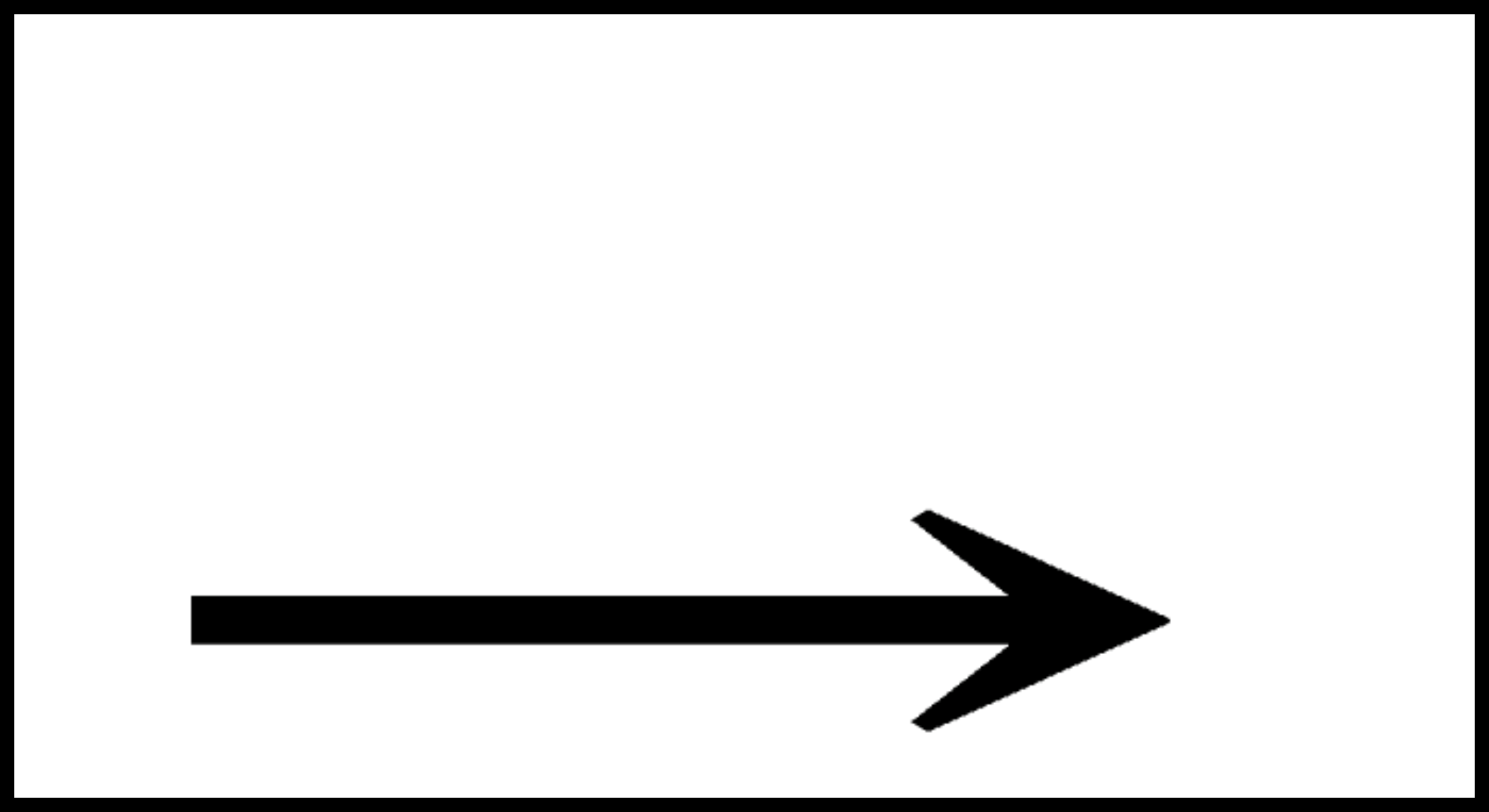
is described like that "There are a Space Base at the top and → at the bottom."
is described like that "There are a Space Base at the top and → at the bottom."
And

is described like that "There are → at the top and a Space Base at the bottom."

is described like that "There are → at the top and a Space Base at the bottom."
These differences are easy to recognize visually but they are difficult to describe verbally. So the Space Base is used.
The sound of it is "mu" (temporaly).
They are placed according to the placement pattern table below, and do not have a shape, but affect the placement.
The sound of it is "mu" (temporaly).
They are placed according to the placement pattern table below, and do not have a shape, but affect the placement.
・Rules about creating words
The size of words
A character must be placed so that it fits into the above compartment (7 horizontal x 6 vertical).
This means that the sum of the vertical values of the entire character must be less than 6 and the sum of the horizontal values must be less than 7.
If this assumption is met, the entire character will be enlarged to the limit of the compartment (for improve readability).
This means that the sum of the vertical values of the entire character must be less than 6 and the sum of the horizontal values must be less than 7.
If this assumption is met, the entire character will be enlarged to the limit of the compartment (for improve readability).
Maximum number of usable bases
The number of bases that can be used per character is limited to 7.
Any more than this, and the placement patterns will become too many and the pronunciation will become redundant (though it is redundant at the moment).
Any more than this, and the placement patterns will become too many and the pronunciation will become redundant (though it is redundant at the moment).
The outermost base of the base in which the "entering" is happening is equally counted as one.
The direction of bases
Some bases have a direction.
To distinguish the directions verbally, bases of the same kind with different directions have different pronunciations.
To distinguish the directions verbally, bases of the same kind with different directions have different pronunciations.
At the moment, there are only two or four directions, but there is a possibility that there will be eight directions in the future.
The following is a base depicting the directions.
|
 |
|
 |
 |
|
 |
 |
|
 |
|
 |
|
 |
 |
 |
|
 |
|
 |
|
 |
|
 |
|
 |
 |
 |
|
 |
 |
 |
|
 |
 |
 |
|
 |
entering
In majuuyu, a base can go inside a base.
I call it "entering" when a base goes inside a base.
The base outside of the letter where the entering is occurring is called the outermost base, and the base inside is called the inside base.
I call it "entering" when a base goes inside a base.
The base outside of the letter where the entering is occurring is called the outermost base, and the base inside is called the inside base.
↓example of words↓
 |
 |
 |
To pronounce orally the letter in which entering is occurring, use
"Su + (outermost base sound) + (inside bases sound) + Su".
Therefore, when entering occurs in →, it is pronounced as "suyasu. When entering occurs at the ←, the pronunciation is "sujasu".
"Su + (outermost base sound) + (inside bases sound) + Su".
Therefore, when entering occurs in →, it is pronounced as "suyasu. When entering occurs at the ←, the pronunciation is "sujasu".
Entering can only be done up to one inside. This means that triple circles, etc. are not possible.
The bases in which entering is occurring have a special way of calculating parcels.
The bases in which entering is occurring have a special way of calculating parcels.
If the inside base is a single "・", the size is counted as (2,2).
Otherwise, the size is calculated using only the inside bases.
However, the outermost base is also counted as one for the number of bases used.
Otherwise, the size is calculated using only the inside bases.
However, the outermost base is also counted as one for the number of bases used.
The following is a list of possible outermost bases and the letter form of outermost base when the content is blank.
When the inside is empty, it is pronounced as "Su + (outermost base sound) + Su".
When the inside is empty, it is pronounced as "Su + (outermost base sound) + Su".
|
 |
|
 |
|
 |
|
|
 |
 |
Layering
In majuuyu, there are times when a base overlaps under a base.
I call it "layering" when a base comes under another base.
In addition, the base where the layering occurs is called the layering base, and the base that comes under the layering base is called the under bases.
I call it "layering" when a base comes under another base.
In addition, the base where the layering occurs is called the layering base, and the base that comes under the layering base is called the under bases.
Note: Creator is not good at English, so the naming is just perfunctory. Please don't be offended if I'm wrong. If you want, please comment in the comments section with a better name.
↓example of words↓
 |
 |
 |
When orally pronouncing the letters in which layering is occurring
"Re + (layering base sound) + (under bases sound) + Re".
Therefore, when layering occurs in →, it is pronounced "reyare".
And so, when layering occurs in ←, it is "rejare".
"Re + (layering base sound) + (under bases sound) + Re".
Therefore, when layering occurs in →, it is pronounced "reyare".
And so, when layering occurs in ←, it is "rejare".
In layering, only one base can be placed on top, while under bases can be placed up to the entire compartment.
The way to calculate the size of the base where layering is occurring is
(the size of layering base)≤(the total size of under bases)
then the total height and width of the under bases is counted as the size of the word, and
(the size of layering base)≤(the total size of under bases)
then the total height and width of the under bases is counted as the size of the word, and
(the size of layering base)>(the total size of under bases) then the size of the layering base is counted as the size of the word.
The number of bases used is the sum of one layering base and the number of under bases.
Distance between bases
In Majuuyu, bases may be attached to bases without any spaces between them.
For example, in the word "majouille," from which this artificial language is derived, each base is completely attached to each other.

For example, in the word "majouille," from which this artificial language is derived, each base is completely attached to each other.

I am still working on how to verbally distinguish this.
It is also expected to have some effects on production.
It is also expected to have some effects on production.
Pronunciation
There are many pronunciations that need to be examined, but for now, here are some tentative pronunciations.
|
|
re reh
|
|
ka kah
|
|
|
|
ki ge kih geh
|
|
ku kuh
|
|
me meh
|
|
|
|
mi pi mih pih
|
|
ra rah
|
|
sa sah
|
|
se seh
|
|
shi shih
|
|
|
|
te da teh dah
|
|
|
|
ya ja yah jah
|
|
|
|
yo jo yoh joh
|
|
yu juh
to
ni
o
ta
n
Grammar
There are still a lot of undecided items, so I'll write about them once the main idea is decided. The grammar will probably be similar to Japanese.
I'm thinking that it might be a good match for Chinese tense expressions.
I'm thinking that it might be a good match for Chinese tense expressions.
Prospects as an international auxiliary language
I'd like to aim for a language that has the position of "sometimes you see it on the information board at the airport...".
I'd also like to see comments on the Internet that are written in Majuuyu, or something like that.
I'd also like to see comments on the Internet that are written in Majuuyu, or something like that.
IME
In the future, Majuuyu would like to be able to input directly in IME.
Direct input here means something like the Hangul IME, which automatically combines the elements.
In addition to direct input, I recently started thinking that it would be nice to be able to convert from other existing languages.
For example, if you type "person" in English, "i" will appear as a conversion candidate, and if you type "people", "iii" will appear as a conversion candidate.
Direct input here means something like the Hangul IME, which automatically combines the elements.
In addition to direct input, I recently started thinking that it would be nice to be able to convert from other existing languages.
For example, if you type "person" in English, "i" will appear as a conversion candidate, and if you type "people", "iii" will appear as a conversion candidate.
The creator is not an expert in programming.
If I want to develop an IME, I will have to study it by myself or ask someone else to do it.
In any case, I need to think about how to input data.
The following is a list of current ideas.
If I want to develop an IME, I will have to study it by myself or ask someone else to do it.
In any case, I need to think about how to input data.
The following is a list of current ideas.
Draft of the process
Receive input from keyboard
↓
Call up placement patterns based on the number of characters entered (up to 7).
↓
Assign the value of the length and width of the bases to the called placement pattern.
↓
Based on the assigned values, find the sum of the length and width of each matrix, and find the maximum value.
↓
Exclude patterns where (maximum horizontal value) > 7 or (maximum vertical value) > 6
↓
For the remaining placement patterns, output images so that the coordinate point "・" is at the center of each base.
Receive input from keyboard
↓
Call up placement patterns based on the number of characters entered (up to 7).
↓
Assign the value of the length and width of the bases to the called placement pattern.
↓
Based on the assigned values, find the sum of the length and width of each matrix, and find the maximum value.
↓
Exclude patterns where (maximum horizontal value) > 7 or (maximum vertical value) > 6
↓
For the remaining placement patterns, output images so that the coordinate point "・" is at the center of each base.
If there is more than one candidate for conversion, machine learning or other methods will be used to prioritize the most frequent words for display.
The following are the placement patterns (6 and 7 are still under construction)
- Number of bases 1
- Number of bases 2
 |
 |
- Number of bases 3
 |
 |
 |
 |
 |
 |
- Number of bases 4
 |
 |
 |
 |
 |
 |
 |
 |
 |
 |
 |
 |
 |
 |
 |
 |
 |
 |
- Number of bases 5
 |
 |
 |
 |
 |
 |
 |
 |
 |
 |
 |
 |
 |
 |
 |
 |
 |
 |
 |
 |
 |
 |
 |
 |
 |
 |
 |
 |
 |
 |
 |
 |
 |
 |
 |
 |
 |
 |
 |
 |
 |
 |
 |
 |
 |
 |
 |
 |
 |
 |
 |
 |
 |
 |
 |
 |
 |
 |
 |
 |
 |
 |
 |
 |
 |
 |
 |
 |
 |
 |
 |
 |
 |
 |
 |
 |
 |
 |
 |
 |
 |
 |
 |
 |
 |
 |
- Number of bases 6
 |
 |
 |
 |
 |
 |
 |
 |
 |
 |
 |
 |
 |
 |
 |
 |
 |
 |
 |
 |
 |
 |
 |
 |
 |
 |
Verb animation feature proposal
I think the verbs in Majeure are rather intuitive and easy to understand (I'm proud of that).
Wouldn't it be much easier to understand if the verbs were animated and the characters really moved?
Wouldn't it be easier to understand?
Wouldn't it be much easier to understand if the verbs were animated and the characters really moved?
Wouldn't it be easier to understand?
If we take into account the fact that we will be spreading the word on the Internetit should not be technically impossible to create a language in which letters move.
Even in the days of Galakay, it was possible to send moving pictograms, so I don't see why it can't be done with Majeure.
Even in the days of Galakay, it was possible to send moving pictograms, so I don't see why it can't be done with Majeure.
The following videos are simulations of what happens when you animate a verb.
It looks really good, doesn't it?
I can see a future where Majuuyu is used on electronic billboards :)
I can see a future where Majuuyu is used on electronic billboards :)
(I recommend right-clicking on the video and playing it in a loop.)
 |
 |
 |
 |
 |
 |
 |
 |
 |
 |
Notes
I'm trying to create a placement pattern for the IME.
There are so many, I'm dying. Someone help me!
I've never heard of such an easy way to go over 100 patterns...
There are so many, I'm dying. Someone help me!
I've never heard of such an easy way to go over 100 patterns...